%20(2).svg)
.svg)

.svg)

.svg)



B2B SaaS Billing Software Buyer’s Guide | Compare Vendors
Billing systems often come under scrutiny as a SaaS business matures beyond simple recurring subscriptions. Contracts diversify. Pricing starts to involve usage. The close takes longer. And leadership starts asking questions the reporting layer can’t easily answer.
This guide outlines how Subscript addresses these realities, how it differs from Chargebee or other tools built for basic subscriptions, and what finance leaders should look for when comparing platforms. The goal is to give you a clear understanding of how Subscript manages complexity, strengthens visibility, and supports the commercial patterns common in B2B SaaS.

“We made the switch from Chargebee to Subscript and haven't looked back! Chargebee led to a lot of headaches, frustratingly never provided quality support and simply isn't set up for software businesses, especially when you get into the intricacies of revenue accounting. Subscript has been incredible and we could not love working with their team more—rockstars building a much needed product.”
Alex Hoimes
VP of Finance and Ops at Drivepoint
Switched to Subscript from Chargebee
Key Differences Between Chargebee and Subscript
TL;DR: Chargebee is often a fit for self-serve, B2C subscriptions, but not for sales-led B2B SaaS, where pricing changes often, contracts vary widely, usage drives revenue, and accounting accuracy matters at scale. Once your pricing model evolves beyond a single plan with predictable renewals, Subscript gives finance teams the flexibility to scale billing, revenue, and analytics from one system.
1. Subscript Is Built for the Realities of B2B SaaS
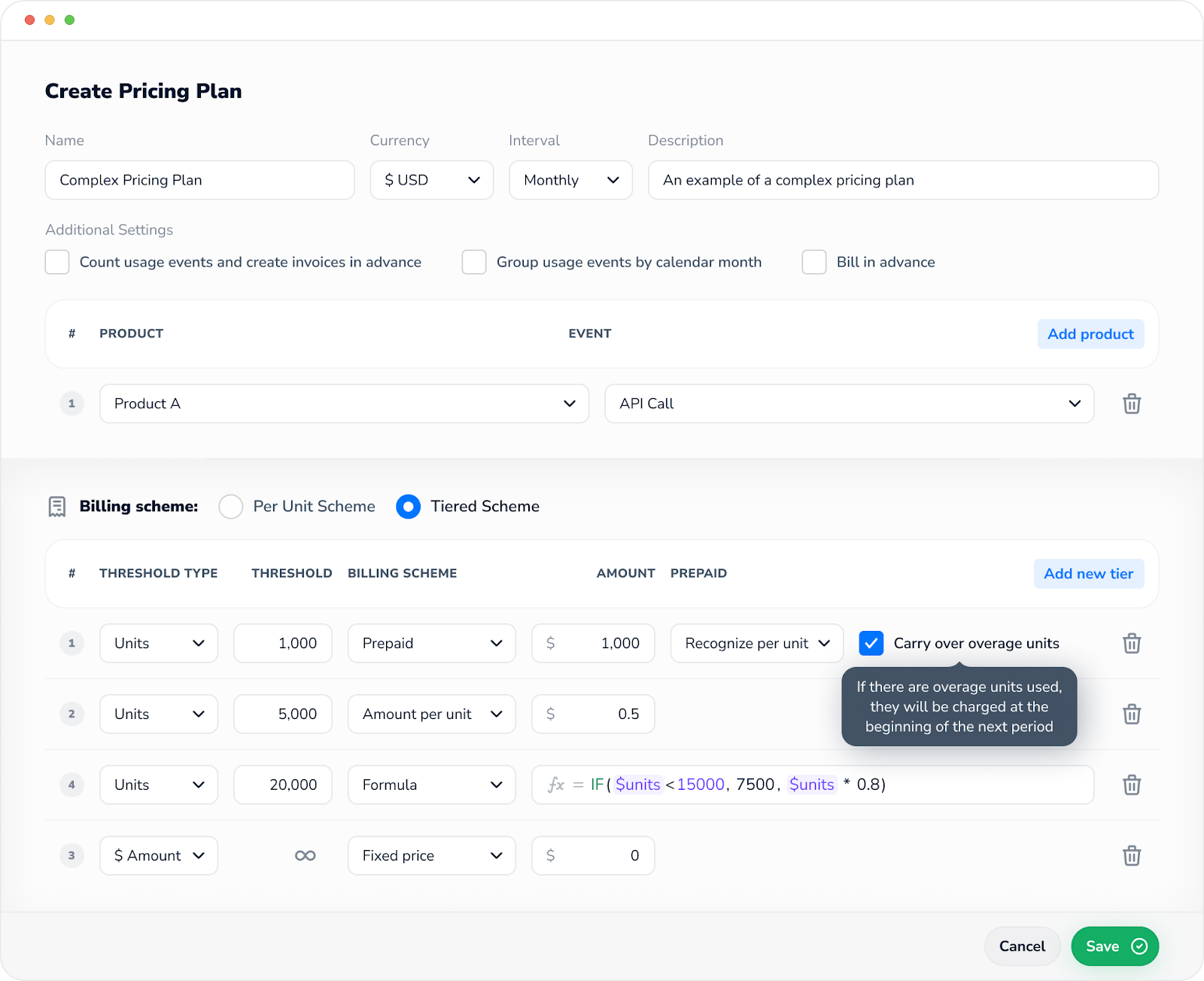
Subscript is designed for companies whose commercial relationships go well beyond a flat subscription. Negotiated terms, usage-based components, tiered pricing, mid-period amendments, parent-child structures, and multi-entity requirements are supported natively.
Subscript reflects how SaaS revenue actually works, so finance teams never need to contort contract terms to fit rigid tooling. The AI contract reader converts agreements into structured billing logic, and invoices are generated automatically even when terms vary customer by customer. Dunning is built directly into the billing engine, and A/R aging reports pull from live system activity. Correcting typos or backdating invoices doesn’t introduce inconsistencies. Updates flow cleanly through billing, revenue, and reporting.
2. A Unified Platform Built for Usage, Complexity, and Change
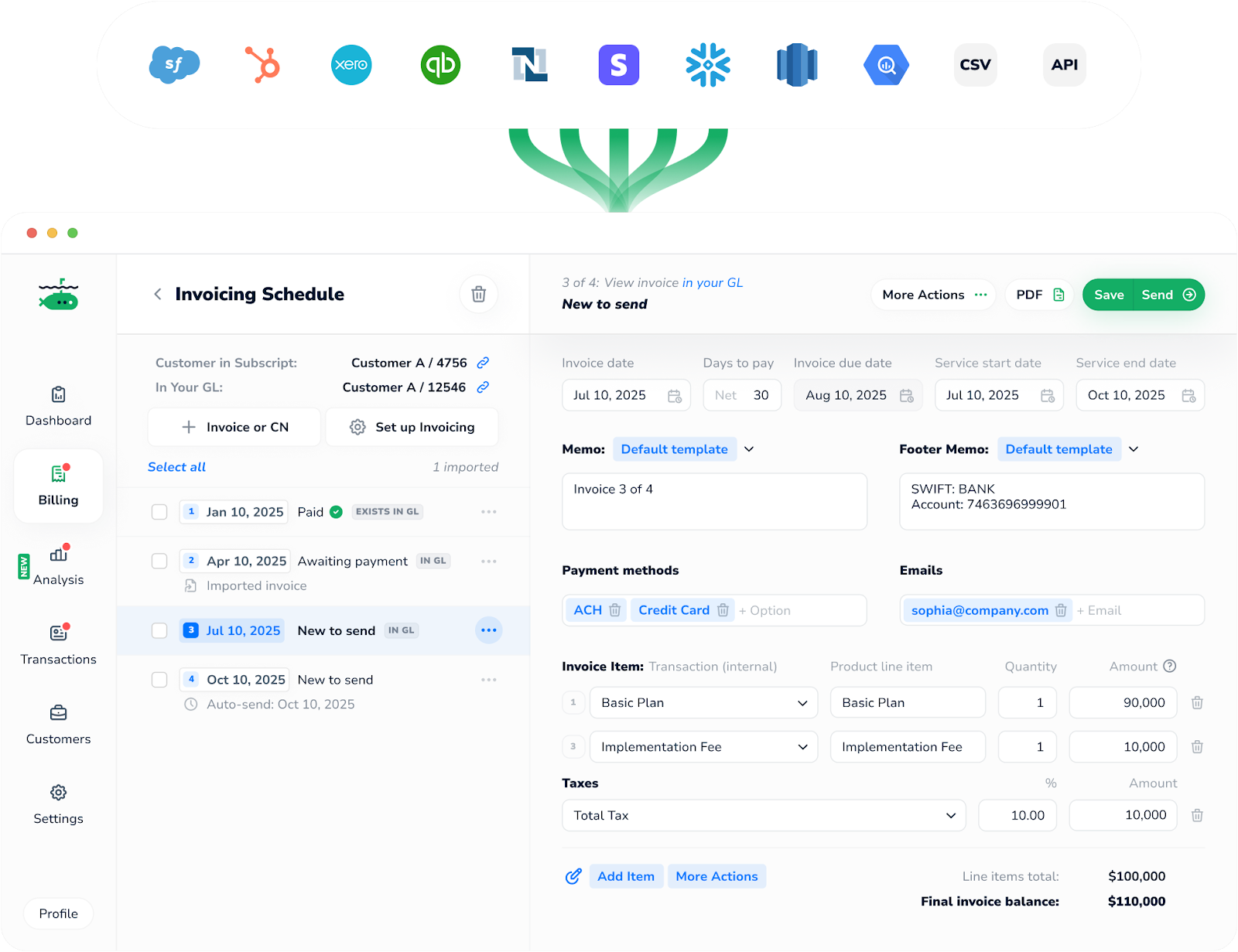
Subscript brings billing, revenue recognition, and analytics into a single system. Contract events, usage activity, revenue schedules, and reporting all share the same architectural backbone, which keeps data aligned at every stage.
Teams evaluating Subscript after using tools with disconnected modules often cite downstream inconsistencies as their biggest source of cleanup. Subscript removes that risk. Two-way integrations with your ERP, CRM, data warehouse, and other core systems keep customer, contract, and financial data synchronized automatically.
The result is infrastructure that scales alongside contract complexity instead of magnifying it.
3. Reliable SaaS Metrics at Your Fingertips
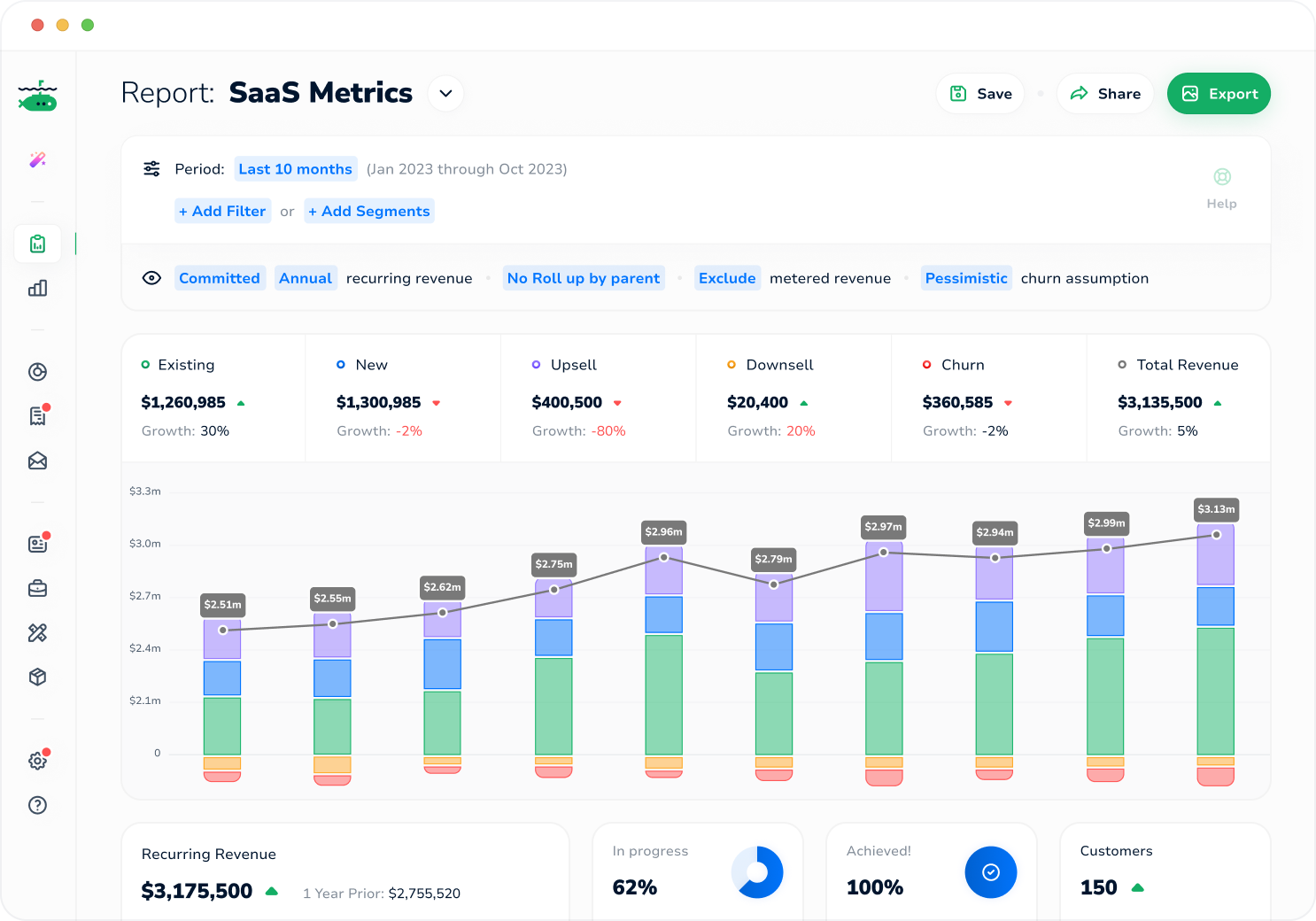
Subscript generates metrics from the same system that manages billing and revenue recognition, eliminating the reconciliation steps that typically sit between accounting systems and BI tools.
Dashboards update continuously. Finance and revenue leaders can share reports directly with executives and cross-functional partners—no exports or offline cleanup required.
Cohorts, waterfalls, segmentation, filtering, and drill-downs all run off unified data, giving teams a dependable view of recurring revenue, expansion, and churn trends.
Why B2B SaaS Teams Switch from Chargebee to Subscript
When companies move from Chargebee to Subscript, it’s often because their commercial model has evolved beyond what a general-purpose subscription tool is built to handle. Finance leaders who’ve made the transition highlight a few recurring themes:
Simple subscription tooling becomes a blocker.
Teams often start on a basic system because the contracts are uniform. Once pricing changes or deal terms diverge, Finance needs tooling that can represent the business accurately. Subscript provides that fidelity.
Usage becomes core to revenue.
Usage introduces timing and accuracy requirements that flat subscription tools can’t support. Subscript treats consumption as a core contract component, keeping usage, billing, and revenue aligned.
Reporting demands increase.
Leadership and investor updates, strategic analysis, and revenue forecasts require trustworthy data. Teams that switch to Subscript consistently report fewer spreadsheets, cleaner reconciliations, and a clearer view of how the business is performing.

“Subscript is built for SaaS. It eliminates the manual spreadsheets, integrates with our CRM, and provides accurate data that I can easily present to the executive team and the board. It has made my job a ton easier, so I definitely would advise any other B2B finance leader to consider it. I’ve already recommended it to a couple other people in my network.”
Jose Medina
Head of Finance at Zuub
Read case study
FAQs: Chargebee vs. Subscript
How is Subscript different from basic subscription billing tools?
Subscript is built for B2B SaaS complexity: custom terms, usage-based pricing, multi-year structures, amendments, and multi-entity operations. Revenue recognition and analytics live in the same system, which eliminates cross-platform reconciliations and keeps data consistent across billing, revenue, and reporting.
How do I know whether Subscript can support our pricing model?
If your pricing includes usage components, hybrid structures, negotiated terms, or frequent amendments, Subscript is built for that level of variability. Workflows remain stable even as contracts evolve.
When evaluating any platform, ask for a walkthrough using your real scenarios. With Subscript, you meet directly with an implementation specialist who reviews your pricing model, covers edge cases, and explains how each one is handled.
How does Subscript handle multi-entity operations?
Subscript supports multi-entity setups with separate customers, currencies, tax rules, and revenue recognition requirements. Consolidation rules are configurable, and entity-level controls keep billing, revenue, and reporting accurate across jurisdictions. Intercompany considerations are scoped during implementation to ensure audit-ready reporting.
What should I expect from the migration?
Subscript provides white-glove migration: contract ingestion, revenue schedule alignment, usage mapping, and reconciliation support. The team handles the heavy lift, validates everything against your current records, and ensures a clean cutover.
What matters most in analytics when choosing a billing platform?
Analytics must answer harder questions as the business matures: Which customers are expanding? Where is usage flattening? How do cohorts behave over time? Can leadership drill into ARR composition without pulling data from multiple systems? A strong billing infrastructure produces decision-grade data that reflects the business accurately and consistently.
How should I think about the ROI of billing and analytics software?
Teams report smoother closes, fewer manual corrections, faster reconciliations, and more reliable SaaS metrics. As pricing becomes more involved or usage becomes central to revenue, the operational return compounds: reduced reliance on spreadsheets, no hand-built revenue schedules, and fewer timing issues at month-end. For example: Zuub saves 20 hours per week on billing and rev rec.
How does Subscript approach support and pricing?
Subscript’s pricing is straightforward, with no revenue share and no separate charges for revenue recognition or analytics. Customers frequently highlight responsive, informed support from a team that understands SaaS accounting and contract workflows.
Compare Subscription Billing Platforms
Review side-by-side summaries of other billing systems finance teams typically assess alongside Subscript, including Maxio, Zuora, and Tabs—informed by real evaluations from finance leaders.
Visit our B2B SaaS Billing Software Buyer’s Guide for deeper context and practical advice.
See Subscript in Action
Subscript is designed for modern B2B SaaS: evolving pricing, complex contracts, usage-based revenue, ASC 606 compliance, and the need for clean, dependable metrics.
Schedule a personalized walkthrough to see how the platform supports your exact pricing model and contract scenarios.


